
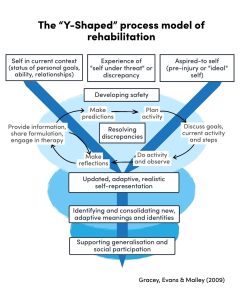
The Y-shaped model is a biopsychosocial process model of neurorehabilitation that locates the majority of post-injury distress in self-discrepancy: the gap between who a person was or hoped to become, and who they now experience themselves to be.
Identity threat, not impairment alone, is theorised in this model to drive a large part of the suffering. The two upper arms of the Y represent the competing self-representations. Rehabilitation proceeds through cycles of behavioural experiment and experiential learning that narrow this gap — depicted by the arms converging — from both directions: through functional gains, compensation, and environmental adaptation, and through revision of the hoped-for self. As the gap closes, the person moves down the trunk toward a renegotiated identity, psychological growth, and re-engagement in valued activity.
By mapping where distress sits and the trajectory of adjustment, the model positions ACT as a natural in-session tool for supporting identity renegotiation.
Y-shaped model and integration with ACT download Y-shaped model image
Watch the video
Reference
Gracey, F., Evans, J. J., & Malley, D. (2009). Capturing process and outcome in complex rehabilitation interventions: A “Y-shaped” model. Neuropsychological Rehabilitation, 19(6), 867 to 890. Available at: alliedneurotherapy.co.uk/Y-shaped-process-model