
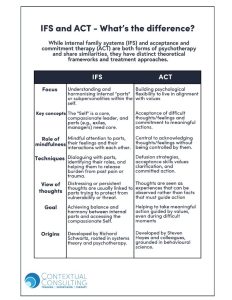
While internal family systems (IFS) and acceptance and commitment therapy (ACT) are both forms of psychotherapy and share similarities, they have distinct theoretical frameworks and treatment approaches that are worth understanding. This worksheet shows a simple overview of some of the main differences between IFS and ACT through their focus, goals, techniques, approach to thoughts and outcomes.
Knowledge hub
Related to your search/filter:
SHAPE framework of contextual behavioural supervision
An overview of SHAPE The SHAPE framework of contextual behavioural sup ...
Read moreNeurodivergence in young people and ACT
Neurodiversity is a term that recognises the natural variations in hum ...
Read moreFunctional analysis and the ABC model
What is functional analysis? Functional analysis refers to the process ...
Read moreInternal family systems (IFS) and ACT
What do we mean by internal family systems (IFS)? Internal family syst ...
Read morePsychological flexibility
Embracing change for a meaningful life What is psychological flexibili ...
Read moreSEED model of ACT supervision
An overview of SEED The SEED model of acceptance and commitment therap ...
Read moreSelf-harm and suicidality in young people
Helping with self-harm and suicidality in therapy with young people is ...
Read moreWhat is acceptance and commitment (ACT) therapy?
An overview of ACT Acceptance and commitment therapy (said as one wor ...
Read moreDNA-V - the ACT model for children and adolescents
What is DNA-V? DNA-V is a combination of acceptance and commitment the ...
Read moreBlog: Latest insights into ACT
Related to your search/filter:
Common issues facing adolescents and using ACT and DNA-V to support them
Adolescence is a time of significant growth, challenge, and opportunit ...
Read moreWorld Book Day 2026 - Save on these ACT books!
We’ve partnered with Hachette/New Harbinger to offer our followe ...
Read moreCBT vs ACT – how do they work with thoughts?
Changing content vs changing impact When it comes to psychological the ...
Read moreWhere to start with ACT
Develop your therapy skills in 2026! When learning acceptance and comm ...
Read moreAdapting ACT for children and young people
10 practical ways to meet young people where they are Acceptance and c ...
Read moreThe balance of connection and challenge in functional analytic psychotherapy
In the therapeutic space, the relationship between therapist and clien ...
Read moreWhy you need to know about emotion efficacy therapy to do ACT
You don’t necessarily need to know emotional efficacy therapy (EET) ...
Read moreUsing Internal Family Systems (IFS) to complement ACT: addressing avoidance
Addressing experiential avoidance is a key aspect of ACT intervention, ...
Read moreUnderstanding the loop: a powerful analogy in PBBT
The loop is a simple yet profound analogy in process based behavioural ...
Read moreAn A-Z of acceptance and commitment therapy (ACT)
As schools in the UK begin returning to the classrooms and we all star ...
Read moreThriving under pressure: Three ways ACT can support sports professionals
For elite athletes, coaches and managers participating in high-stakes ...
Read moreSupporting children and young people's mental health – a necessity not a luxury
While the emotional well-being of our youth is acknowledged as a key c ...
Read moreMental health awareness week - Free introduction to ACT
Free introduction to ACT We’re supporting the Mental health foun ...
Read moreMastering the moves: What chess can teach us about therapy
Can chess teach us how to master therapy? During therapy sessions, the ...
Read moreResource hub
Related to your search/filter:
Case studies: Using ACT and DNA-V to support adolescents
Psychological flexibility models, such as ACT and the DNA-V model (dev ...
Read moreTrauma and PTSD - Similarities and differences
From a psychological flexibility perspective, both trauma responses an ...
Read moreHormones in motion: Understanding women’s transitions across the lifespan
Menopause is often described as an endpoint, a singular biological mil ...
Read moreSeven types of rejection
This download is taken from a blog written by Jennifer Kemp, entitled ...
Read moreEMDR and ACT - Similarities and distinctions
While eye movement desensitisation and reprocessing (EMDR) and accepta ...
Read moreMastering Therapy S4 E1 - 6 things the best ACT therapists do differently - Dr Joe Oliver
In this episode of Mastering Therapy, host Natalie Stott interviews ou ...
Read moreClient case studies: Menopause and ACT
Acceptance and commitment therapy (ACT) does not seek to eliminate men ...
Read moreA-Z of ACT metaphors
Following our A-Z of ACT, we challenged ourselves to come up with an ...
Read moreCBT vs ACT – how do they work with thoughts?
One of the key differences between CBT and ACT lies in how they aim to ...
Read moreWhat is acceptance and commitment (ACT) therapy ebook
An introductory guide to ACT This guide has been designed for practiti ...
Read more3 essential leadership skills supported by ACT
ACT offers practical and transformational tools for workplaces and lea ...
Read moreSleep and self-care: an ACT-based approach to better rest
Sleep problems can be very common, with most people experiencing sleep ...
Read moreThe SHAPE model for ACT supervision
The SHAPE model by Linda Nicholson & Eric Morris is a helpful fram ...
Read moreCBT and ACT - What's the difference? handout
While cognitive behavioural therapy (CBT) and acceptance and commitmen ...
Read moreCFT and ACT - What's the difference?
While compassion-focused therapy (CFT) and acceptance and commitment t ...
Read more3 emotional systems, as used in compassion-focused therapy (CFT)
On this page, we have compiled a range of free resources that present ...
Read moreApplying the ACT Hexaflex to end-of-life care
The acceptance and commitment therapy (ACT) framework including the us ...
Read morePhysical health/chronic pain case study - Jeremy's story
This fictional case study explores “Jeremy’s story” ...
Read moreMentally Flexible podcast - Dr Joe Oliver, ACTivate your life
In this episode of the mentally flexible podcast, host Tom Parkes, ...
Read moreMeaningful change through shaping: reinforce, evoke, and model - Lou Lasprugato expert tip
Shaping behaviour is an essential component of ACT (acceptance and com ...
Read moreThe ACT fidelity measure (ACT-FM)
The ACT fidelity measure (ACT-FM) is designed for clinicians experienc ...
Read moreACT in perspective - PBBT with Dr Yvonne Barnes-Holmes
Process-based Behaviour Therapy with Dr Yvonne Barnes-Holmes In this e ...
Read more5 ways anger can appear
It’s crucial to possess honed clinical skills in assessment and inte ...
Read more5 subtle ways anger shows in therapy
Anger is a complex emotion that doesn’t always manifest as loud out ...
Read more6 different ways of relating
This infographic gives a simple description of 6 different ways we ca ...
Read more4 steps to arrive at a difficult conversation
Having the right approach to difficult conversations can make all the ...
Read moreThe Sport Psych Show: Episode #257
Achieving your potential in sport and life – Dr Alison Maitland ...
Read moreA simple way to explain Relational Frame Theory (RFT) - Dr M Joann Wright
In this expert tips for ACT video Dr. M. Joann Wright demonstrates a s ...
Read morePsychological Flexibility with Dr Joe Oliver
In this video, Dr Joe Oliver talks through the concept of psychologica ...
Read moreACT basics - The six core processes of acceptance and commitment therapy
This set of videos is taken from our ACT basics series on our YouTube ...
Read moreABC model of functional analysis
Here we have created and collated a range of images that will be usefu ...
Read more4 tips to improve psychological flexibility
Psychological flexibility is a vital principle of acceptance and commi ...
Read moreA-Z of ACT - acceptance and commitment therapy
Head ‘back to school’ with our A-Z of acceptance and commi ...
Read moreAn overview of the ACT model with Dr Joe Oliver
In this video Dr Joe Oliver talks through an overview of acceptance an ...
Read moreThe power of letting go - script
In this script we look at the experience of Sam, a fictional client. S ...
Read moreThe mindfulness and acceptance workbook for self-esteem
Grounded in evidence-based acceptance and commitment therapy (ACT), th ...
Read moreIdentify the DRAIN in your relationship - worksheet
This worksheet is taken from Dr Russ Harris’ book – “AC ...
Read moreThe Journey Home: Dr Joe Oliver - podcast
This episode of The Journey Home podcast features an interview with Co ...
Read moreSweet spot exercise
This script, shared by Dr Kristy Potter, of an exercise developed by W ...
Read moreSoothing hand script
This script, shared by Dr Kristy Potter is a well-known exercise that ...
Read morePrincess and the pea (expansion) script
This script from Dr Kristy Potter uses the well-known fairy-tale ̵ ...
Read moreInternal family systems (IFS) - Dr. Richard Schwartz explains
Pioneered by Dr. Richard Schwartz in the 1980s, Internal family system ...
Read moreInternal family systems (IFS) - reading list
Internal family systems (IFS) is a revolutionary form of psychotherapy ...
Read moreACT/ MBSR workplace intervention for sleep – ACBS Berlin 2015 Conference
The effectiveness of a workplace ACT intervention compared to MBSR tra ...
Read more
