
What do we mean by neurological conditions?
Neurological conditions refer to disorders that affect the brain, spinal cord, and nerves, which collectively form the nervous system. These include a broad spectrum of conditions such as multiple sclerosis (MS), Parkinson’s disease, stroke, epilepsy, traumatic brain injury (TBI), migraines, and motor neurone disease (MND). These conditions can be progressive, static or episodic, with varying impacts depending on their severity and the areas of the nervous system affected.
What symptoms might someone experience?
Neurological conditions can lead to a diverse array of symptoms reflecting the various roles of the nervous system. These might include:
- Physical symptoms: muscle weakness, spasticity, tremors, balance issues, or even paralysis.
- Sensory symptoms: pain, numbness, tingling sensations, or heightened sensory sensitivity.
- Cognitive challenges: difficulties with memory, processing, language, or attention.
- Emotional and mental health impacts: anxiety, depression, irritability, or apathy.
- Fatigue: one of the most pervasive and often debilitating symptoms.
- Changes in motor function: problems with coordination, speech, or fine motor skills.
The unpredictability and variability of symptoms, both day-to-day and longer term, can make living with neurological conditions particularly challenging.
What are usual courses of treatment and how does ACT fit in?
Treatment for neurological conditions often combines medical, rehabilitative, and psychological approaches. Medications may be prescribed to manage symptoms (e.g., anti-seizure medication for epilepsy), slow disease progression (e.g., dopaminergic treatment in Parkinson’s), or alleviate associated issues (e.g., antidepressants for emotional challenges). Rehabilitative therapy (e.g., physiotherapy, occupational therapy, speech therapy) aims to maintain or improve function and independence.
Psychological interventions are equally crucial for addressing the emotional and cognitive burden of these conditions. Acceptance and commitment therapy (ACT) fits well within this framework by helping people adapt and thrive despite their difficulties. Rather than focusing solely on reducing symptoms or pathology, ACT emphasises creating a life of meaning and connection, supporting individuals to move forward even in the presence of ongoing challenges. This makes ACT a particularly powerful tool in rehabilitation.
A model that aligns beautifully with ACT principles and can help illustrate this fit is Gracey, Evans, and Malley’s (2009) Y-shaped process model of rehabilitation.
The Y-shaped model
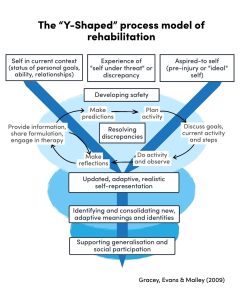 Gracey, Evans, and Malley (2009) Y-shaped model, developed at the Oliver Zangwill Centre, is a biopsychosocial process model of neurorehabilitation. It locates much of the distress after acquired injury in self-discrepancy: the gap between the self a person was, or hoped to become, and the self they now experience. It theorises that identity threat, not impairment alone, drives a large part of the suffering.
In the model, the two upper arms of the Y represent these competing self-representations, held apart by that discrepancy. Rehabilitation proceeds through repeated cycles of behavioural experiment and experiential learning, which work to reduce the discrepancy; the converging arms of the Y. Crucially, discrepancy can narrow from both directions: through genuine functional gains, compensation, and environmental adaptation that move current functioning closer to the hoped-for self, and through revising the hoped-for self itself. As the gap reduces, the person moves down the trunk of the Y toward a renegotiated identity, psychological growth, and re-engagement in meaningful, valued activity.
The model tells us where the distress sits and the trajectory of adjustment. ACT, can be a helpful intervention to support the adjustment process.
Integrating ACT with the Y-shaped model
The two frameworks are unusually compatible: both are experiential and behavioural, and neither treats symptom elimination as the target. The Y is the formulation; the ACT processes are the engine that moves a person along it.
- The discrepancy ↔ the conceptualised self. The “old” or “ideal” self a person is fused with is, in ACT terms, a self-concept being held as literal truth. Defusion and contact with self-as-context, the observing self that persists through every change, are what let identity be held lightly enough to be revised. This is the deepest point of contact: the Y calls for identity renegotiation; ACT provides the mechanism.
- The restoration struggle ↔ experiential avoidance. Insisting that the only acceptable outcome is the return of the former self is, functionally, an unwillingness to contact the grief of the gap. Named as avoidance rather than as denial or poor motivation, it becomes workable and is far less blaming.
- Convergence of the arms ↔ willingness and valued action. The gap narrows as the person becomes willing to feel the loss without being ruled by it, and as valued action builds a workable present self and not by restoration alone.
- Behavioural experiments ↔ committed action. The Y’s mechanism of change is cycles of behavioural experiment and experiential learning. That is ACT’s committed action and present-moment work; the method is already shared.
- The trunk of the Y ↔ values. “Adjusted identity” raises the question — adjusted around what? Values give the renegotiated self its content and its direction.
Why ACT is particularly suited to neurological conditions
ACT is uniquely suited to neurological conditions because it helps individuals navigate the uncertainty, unpredictability, and emotional strain caused by these conditions.
Key reasons include:
- Supports identity renegotiation: As the Y-shaped model describes, much of the distress after injury comes from the discrepancy between the hoped-for self and the current self. ACT’s work on defusion, self-as-context, and values is what allows that identity to be revised and the gap to narrow, making it a natural fit for neurorehabilitation.
- Focus on psychological flexibility: ACT helps individuals develop the capacity to adapt, pivot, and respond effectively to life’s challenges—even when symptoms persist or worsen.
- Acceptance of uncontrollable realities: Rather than fighting against limitations or difficult symptoms, ACT promotes acceptance and helps shift energy towards what truly matters.
- Helps redefine purpose and meaning: Neurological conditions often disrupt one’s sense of identity or purpose. ACT provides tools to help individuals reconnect with what is meaningful to them in their “new normal.”
- Addresses emotional distress: ACT provides a way to process and make space for difficult thoughts and feelings about the condition, offering an alternative to suppression or denial.
Overall, ACT, when combined with models like the Y-shaped process, builds the foundation for a compassionate, integrative approach to neurological rehabilitation. We thought this quote from Richard Coates’ book, Innovations in Acceptance and Commitment Therapy (ACT) for Acquired Brain Injury, made by Lucy, a stroke survivor, perfectly sums up how powerful psychological interventions can be; “The neurosurgeons saved my life, but it was the psychologists who showed me there was a life to live“. ACT interventions are about helping people to live well, bridging the gap between loss and living to navigate the complexities of their condition.
Whether through structured programmes or creative, individualised interventions, ACT offers therapists and clinical psychologists a dynamic approach to support clients on their journey toward a rich, meaningful life.
For individuals:
If you have a neurological condition that is significantly affecting your daily life and wellbeing, it is advisable to consult a healthcare professional to help provide a proper diagnosis and suggest appropriate treatment options. For guidance and tailored support in applying ACT principles to manage your symptoms you can speak to one of our trained therapists
For professionals:
Our live training and on-demand courses help to upskill practitioners in ACT and associated approaches or modalities with specific workshops covering various issues including neurological conditions. Our free resources and blog also offer additional reading and insight.
References:
Coates, R (2024) Innovations in Acceptance and Commitment Therapy (ACT) for Acquired Brain Injury (The Neuro-Disability and Psychotherapy Series) – Chaptr 5. Routledge, London
Gracey, Evans, and Malley (2009) Capturing process and outcome in complex rehabilitation interventions: A “Y-shaped” model. Article in Neuropsychological Rehabilitation
Resources related to Neurological conditions and ACT
Navigating Neuropsychology: Ep 192 - ACT for brain injury – A conversation with Drs. Abigail Methley and Will Curvis
This episode of the NavNeuro/Navigating Neuropsychology podcast discus ...
Read more