

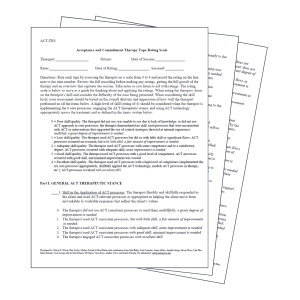
 The acceptance and commitment therapy tape rating scale (ACT-TRS) is a tool designed to assess therapists’ competencies in implementing the six core processes and broader ACT-based techniques.
A four-part structure ensures a wide-ranging evaluation of the therapist’s competence in delivering ACT interventions while allowing flexibility to account for session-specific factors.
Download ACT-TRSMore about the acceptance and commitment therapy tape rating scale (ACT-TRS)
Below are the key sections of the ACT-TRS and types of questions contained within each:
1. General ACT therapeutic stance
This section evaluates the therapist’s overall engagement with ACT processes and their relational approach toward the client.
- Skill in the application of ACT processes: Assesses how flexibly and skilfully the therapist integrates ACT to guide the client toward workable, values-based responses.
- Interpersonal relationship: Rates the therapist’s ability to engage respectfully, compassionately, and genuinely from an equal and vulnerable perspective with the client.
- Modelling ACT processes in the therapeutic relationship: Measures whether the therapist demonstrates ACT principles, such as acceptance and defusion, within their interaction with the client.
2. ACT technology
This section focuses on the therapist’s application of ACT methods and tools.
- Strategy for behaviour change: Reviews the therapist’s ability to create and implement an ACT-based case conceptualisation, addressing issues like experiential avoidance and environmental barriers.
- Implementation of metaphors and exercises: Assesses the therapist’s understanding and use of ACT-appropriate metaphors and tools at suitable moments during therapy.
- ACT-consistent homework: Evaluates whether therapists provide meaningful, values-based homework to promote flexible, values-driven behaviour outside sessions.
3. ACT core competencies
This section measures the core therapeutic processes of ACT, assessing how well therapists facilitate client progression within each process. For each competency, responses range from poorly implemented (0) to high skill (4), or not applicable if irrelevant to the session.
- Willingness/acceptance: Rates the therapist’s ability to promote experiential acceptance as an alternative to internal control strategies.
- Cognitive defusion: Measures skill in helping clients view thoughts as behavioural events rather than absolute truths, encouraging responses based on values rather than literal content.
- Present moment: Evaluates techniques used to cultivate client awareness and attention to the present moment.
Self-as-context: Assesses how well the therapist helps clients experience themselves as the observer of thoughts and emotions, separate from the content itself. - Valued direction: Looks at the therapist’s ability to assist clients in clarifying values and embedding behaviour change within those values.
- Committed action: Reviews how effectively therapists guide clients to implement sustained, values-based behavioural change.
4. Other issues
This section highlights extraordinary aspects or deviations in the session.
- Unique or extraordinary problems: Evaluates how well the therapist addresses significant or unexpected challenges during the session.
- Significant protocol departures: Identifies instances where therapists diverged from the ACT framework and examines whether this was justified.
- Inconsistencies with ACT theory and application: Checks for any interventions made that deviate from ACT principles, such as using control strategies or suggesting the suppression of internal experiences.
Scoring
- Scores are assigned per question, either from 0 to 4 or marked as not applicable (NA) if a core competency is irrelevant to the session.
- A total score can be calculated by averaging the ratings of scored items. Comments and suggestions for improvement can also be included to provide detailed feedback.
This structure ensures a wide-ranging evaluation of the therapist’s competence in delivering ACT interventions while allowing flexibility to account for session-specific factors.
The ACT-TRS was developed by: Robyn D. Walser, Barr Taylor, Mickey Trockel & Brad Karlin with contributions from John Billig, Scott Cornelius, James Gillies, Jennifer Gregg, Steven Hayes, Lutz Hess, Kelly Koerner, Jason Luoma, Kevan McCutcheon, DJ Moran, Vince Roca, Alethea Varra, and Darrah Westrup. For information: robyn.walser@va.gov
