

Brief summary
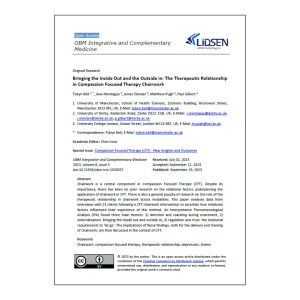 This research focuses on the role of the therapeutic relationship in compassion-focused therapy (CFT) chairwork, an experiential method for addressing self-criticism and fostering compassion. Twenty-one clients participated, offering insights into their experiences with relational dynamics during chairwork. Using interpretative phenomenological analysis, three main themes — direction and coaching, externalisation and self-consciousness, and trust and regulation — arose, illuminating the relational factors that underpin the intervention.
Key findings
- Direction and coaching: Participants valued therapists’ directive role in guiding the chairwork process, helping them immerse in and navigate the exercise. Therapists acted as directors and emotional coaches, encouraging deeper engagement and connection with emotions.
- Externalisation and shame: While externalising their emotional states improved self-awareness, many participants initially felt shame and embarrassment. However, they ultimately saw the therapist’s non-judgemental witnessing as validating and healing.
- Trust and regulation: A pre-existing strong therapeutic relationship significantly influenced participants’ ability to engage in chairwork. Therapists were pivotal in providing emotional regulation and modelling compassion, allowing clients to adopt similar self-compassionate stances.
Practice recommendations
- Develop strong alliances: Build trust and rapport early in therapy, as these are essential foundations for effective chairwork, particularly for clients vulnerable to shame and self-criticism.
- Adapt interventions to client needs: Provide clear guidance and adjust the level of direction to suit individual preferences, helping clients feel contained and supported in the exercise.
- Acknowledge and normalise clients’ shame: Address initial feelings of shame by reinforcing a safe, non-judgemental therapeutic environment to encourage authentic emotional expression.
- Incorporate compassionate modelling: Therapists should embody compassion overtly during chairwork, offering a clear framework for clients to internalise and replicate.
Reference
Bell, T., Montague, J., Elander, J., Pugh, M., & Gilbert, P. (2023). Bringing the inside out and the outside in: The therapeutic relationship in compassion focused therapy chairwork. OBM Integrative and Complementary Medicine, 8(3). https://doi.org/10.21926/obm.icm.2303037
View study
